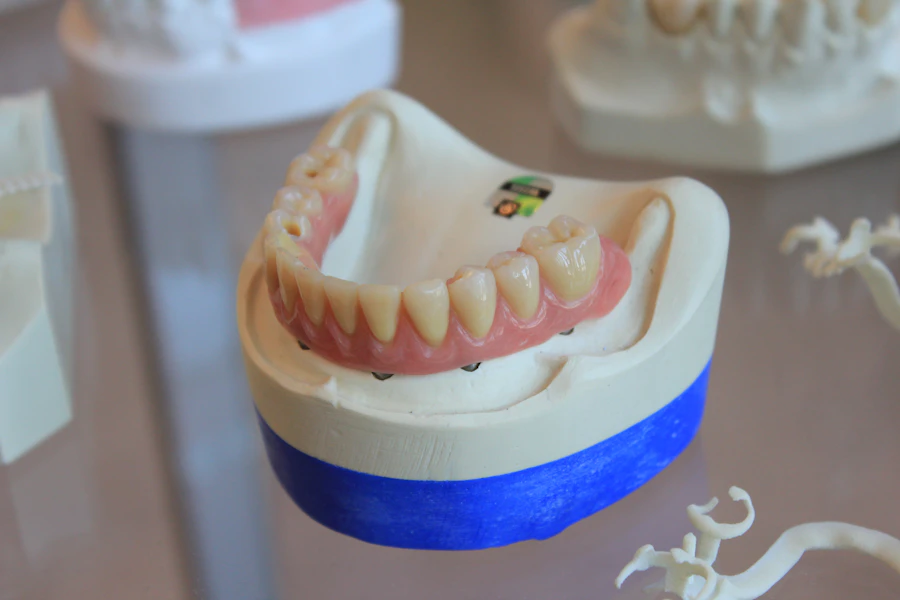
Dental Prosthetics
Fixed and removable prosthetic applications used to replace missing teeth.
The Difference Between Fixed and Removable Prostheses
Fixed prostheses (crowns and bridges) are supported by the remaining teeth or by implants and are not removed by the patient. Removable prostheses can be taken out of the mouth and are planned as either partial or complete depending on the condition of the remaining teeth. A fixed prosthesis requires a sufficient number of sound abutment teeth or implants. Where support is inadequate, removable options are considered.
Complete Dentures and Retention
Complete dentures, used where all teeth have been lost, behave differently in the upper and lower jaw. In the upper jaw the palatal surface is broad, so the suction effect is more pronounced. In the lower jaw the seating area is narrower and movements of the tongue and lips continually displace the denture, so retention is generally more limited. Retention varies between individuals according to the shape of the jaw bone, the thickness of the gum tissue and the amount of saliva.
Implant-Supported Prostheses
Where the retention of a removable denture is inadequate, prostheses seated on implants placed in the jaw bone may be considered. These can be planned as removable with locator attachments, or as fixed and screw-retained. Applicability depends on bone volume, gum health and general medical condition, and is decided only after radiological evaluation.
Adaptation and Care
Speaking and chewing with a new prosthesis feels different during the first days. Pressure points may develop on the gum in this period; adjustment at review appointments is a normal stage of the process. Removable prostheses need to be taken out and cleaned every day and stored as advised by the dentist. Because the jaw bone changes shape over time following extraction, relining or renewal of the prosthesis may be required at intervals.
Frequently Asked Questions
Is a fixed or a removable prosthesis suitable?
This choice depends on the condition in the mouth rather than on preference alone. A fixed prosthesis requires a sufficient number of sound abutment teeth or implants for the bridge to rest on. If the remaining teeth are periodontally weak or the gap is very wide, a fixed solution may not be appropriate. Where bone volume is adequate, fixed options may become possible again with implant support. The decision is made together after examination and radiological evaluation.
Will a complete denture stay in place?
The retention of a complete denture is not something that can be committed to in advance; the shape and height of the jaw bone, the condition of the gum tissue, the amount of saliva and muscular habits are decisive. In the upper jaw retention is generally better owing to the breadth of the palatal surface; in the lower jaw it can be more limited. Where retention proves inadequate, implant-supported options may be considered.
How many appointments does a prosthesis take?
The number of appointments varies with the type of prosthesis. Removable prostheses require several visits covering impressions, try-in and fitting, with laboratory work between each stage. Fixed prostheses involve tooth preparation, impression and cementation stages. If extraction or implant placement is needed, additional healing time is planned. A definite duration can only be given once the treatment plan has been drawn up.
How long does it take to adapt to a new prosthesis?
Changes in speech, increased salivation and a feeling of fullness are usual in the first days and generally diminish over time. Tender spots may develop on the gum from pressure, and adjusting these at review appointments is a normal part of treatment. The adaptation period varies between individuals. If pain, ulceration or persistent displacement of the prosthesis continues, it should be assessed without waiting.
The information on this page is for general information purposes and does not replace a clinical examination. The suitability, duration and alternatives of treatment can only be determined by your dentist after clinical and, where required, radiological evaluation.
This treatment is carried out at the clinic in Yeşilbahçe, Muratpaşa, Antalya. Location and directions.