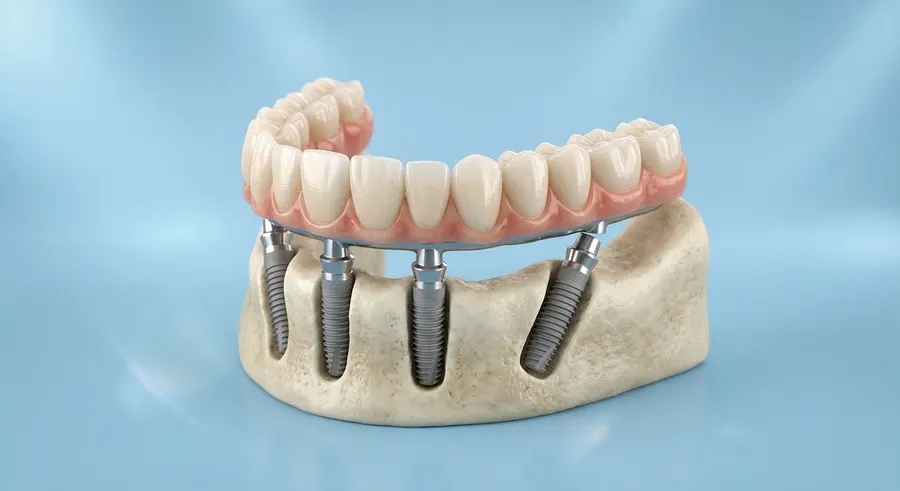
All-on-4 Implants
A fixed prosthesis on four implants for a fully toothless jaw.
Same-Day Provisional Fixed Prosthesis
With the All-on-4 technique, when the bone structure and the initial stability of the implants allow, a provisional fixed prosthesis can be fitted to the implants on the day of surgery. The permanent prosthesis is made after the healing period.
In Jaws With Bone Loss
Bone loss is common in jaws that have been without teeth for a long time. In the All-on-4 technique, implants are placed at an angle in the denser areas of the bone; in some cases this can reduce the need for extensive bone grafting.
The Treatment Process
Using fewer implants than plans with a separate implant for each tooth, and the possibly reduced need for additional surgery, can lower the number of visits. Whether treatment is suitable, and how long it takes, is determined by clinical examination and radiological assessment.
What Is a Hybrid Prosthesis?
In All-on-4 and All-on-6 treatment, a hybrid prosthesis is used as the permanent prosthesis. A hybrid prosthesis is a fixed prosthesis in which the teeth and a gum section are set on a strong framework and which is attached to the implants with screws. It is not removed by the patient; when needed, it can be removed by the dentist for maintenance and check-ups. Aids such as interdental brushes or a water flosser are recommended for cleaning under the prosthesis; regular check-ups allow the prosthesis and the tissues around the implants to be monitored.
When Is All-on-6 Planned?
When bone volume and jaw structure allow, the fixed prosthesis can also be planned on six implants instead of four; this approach is called All-on-6. How many implants are used is decided by assessing the amount and density of bone, the teeth in the opposing jaw and the chewing forces.
Passive Fit: Digital Scanning and Photogrammetry
In prostheses made in one piece on several implants, it is important that the framework seats on the implants without creating strain, that is, passively; an ill-fitting framework can lead to screw loosening and mechanical problems. At our clinic, when taking impressions for these prostheses, a separate record is taken with a photogrammetry device in addition to intraoral digital scanning. Photogrammetry records the position of the implants relative to each other by photographing markers attached to the implants with a camera, while the intraoral scan records the shape of the gums and surrounding tissues. The two records are used together in planning the prosthesis framework.
Frequently Asked Questions
How does All-on-4 differ from conventional implants?
In the conventional approach a separate implant may be planned for each missing tooth. All-on-4 describes a fixed prosthesis seated on four implants in an edentulous jaw. The two posterior implants are placed at an angle so that the available bone is used more efficiently. It is therefore considered as an option that may reduce the need for grafting in patients with reduced bone volume in the posterior region.
Why are four implants enough?
The number alone is not decisive; the distribution and angulation of the implants across the jaw is what allows the load to be shared. Tilting the posterior implants widens the support area and allows the prosthesis to extend into the posterior region. Even so, four implants are not suitable in every case; more may be planned according to the bone structure. The decision is made by radiological evaluation.
Can teeth be fitted the same day?
In some cases a temporary fixed prosthesis can be placed on the day the implants are inserted. The condition for this is that the implants show sufficient initial stability at placement; this is measured during surgery and cannot be committed to in advance. If stability is inadequate, healing is awaited. The permanent prosthesis is prepared once healing is complete.
Who is All-on-4 not suitable for?
Uncontrolled systemic disease, heavy smoking, untreated gum disease and insufficient bone volume in the region where implants are to be placed are the principal limiting conditions. Certain medications also affect the assessment. Suitability is determined after clinical examination and three-dimensional radiological evaluation.
What is a hybrid prosthesis?
A hybrid prosthesis is a fixed prosthesis used in full-arch implant treatments such as All-on-4 and All-on-6, in which the teeth and a gum section are set on a strong framework. It is attached to the implants with screws; it is not removed by the patient, and when needed it can be removed by the dentist for maintenance. The area under the prosthesis is cleaned with aids such as interdental brushes or a water flosser.
What is photogrammetry and why is it used?
Photogrammetry records the position of the implants relative to each other by photographing markers attached to the implants with a special camera. Because it is important that the framework of a one-piece prosthesis on several implants seats without strain, this record is taken at our clinic in addition to intraoral digital scanning, and the two records are used together in planning the prosthesis.
The information on this page is for general information purposes and does not replace a clinical examination. The suitability, duration and alternatives of treatment can only be determined by your dentist after clinical and, where required, radiological evaluation.
This treatment is carried out at the clinic in Yeşilbahçe, Muratpaşa, Antalya. Location and directions.