How Long Does Composite Bonding Last? Care, Polishing and Repair
What determines how long bonding lasts, what to watch in the first days and over the long term, and the polishing and repair carried out at check-ups.
Why Can't a Single Period Be Given?
The most common question from people considering composite bonding is how many years it will last. Answering with a single number would not be accurate, because how long a restoration remains in the mouth depends more on the conditions in that mouth than on the material. Two bondings made with the same technique behave very differently in someone who clenches and bites hard food with the front teeth and in someone without these habits.
Rather than committing to a period in advance, it is therefore more meaningful to know the factors that determine it and to manage them.
Factors That Determine How Long It Lasts
- Forces on the teeth: Clenching, grinding, nail biting, chewing pens and cracking nuts with the front teeth are the main causes of edge chips in composite.
- Thickness and position of the composite: Composite that lengthens the biting edge or takes direct contact when biting carries more load than composite added only to a side surface.
- The bite: Early contacts or a deep bite on the front teeth can concentrate force at a particular point.
- Staining habits: Tea, coffee, red wine, cola and smoking speed up surface staining.
- Oral hygiene: Plaque collecting at the junction between composite and tooth leads to both gum inflammation and margin staining.
The First 48 Hours
Composite is light-cured during the procedure and is ready for use at the end of the session; there is no need to wait before eating. However, the surface is more prone to staining in the first two days, so reducing strongly coloured drinks and foods is recommended. The tongue may take a few days to get used to the new surface; a slight difference felt during this time usually settles by itself.
Long-Term Daily Care
Caring for bonding is not very different from caring for natural teeth. Brushing twice a day and cleaning between the teeth with floss or an interdental brush are enough. Whitening toothpastes with abrasive particles can remove the gloss of the composite surface faster, so they are best avoided for continuous use.
Avoiding biting hard objects with the front teeth is the most effective protective measure. For people with signs of night-time clenching, a night guard protects both the teeth and the composite; we cover this in detail on the teeth clenching treatment page.
What Happens at Check-Ups?
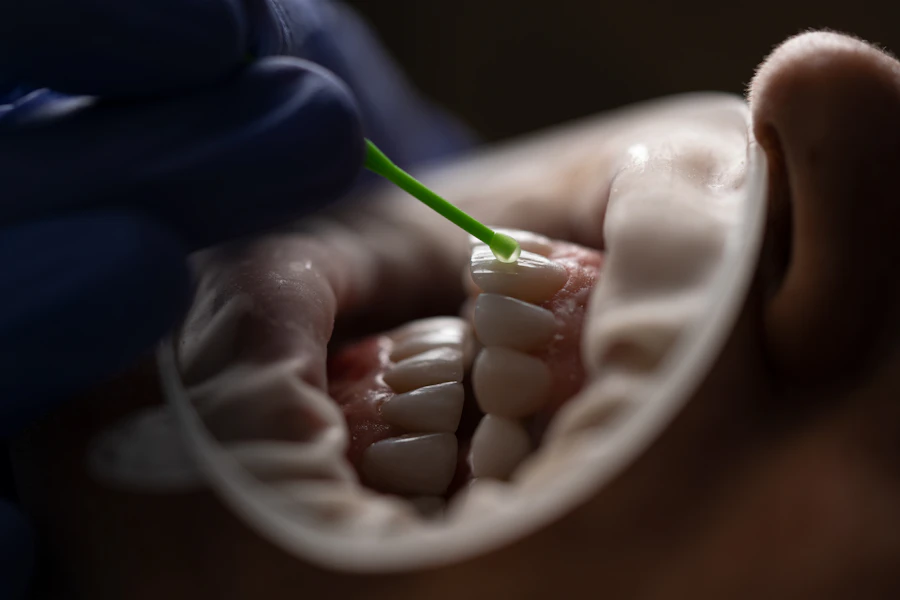
At regular check-ups the composite margins, surface gloss and bite contacts are examined. Staining or dullness on the surface is removed by polishing. A small chip or wear at the edge is built up with the same material. These small interventions keep the restoration looking good for a long time without needing to replace it entirely.
This is one of the clearest advantages of composite over porcelain: problems can be resolved in the mouth, before they grow, and often in a single session.
When Should You Come In?
- When a rough spot or chip that you can feel with your tongue appears at the edge,
- When floss starts catching or shredding at the edge of the composite,
- When you notice marked surface staining or a dark line at the edge,
- When sensitivity to hot or cold starts that was not there before,
- When you feel a new contact or knock between the teeth when biting.
Most of these are resolved with a small adjustment when dealt with early. You can read how composite bonding is done and who it suits on the composite bonding page, and how it differs from porcelain veneers in the article composite or porcelain veneers.
This article is for general information purposes only and does not replace a clinical examination. The method that suits you, the scope of treatment and its alternatives can only be determined by your dentist following a clinical examination.